[No tokens have been burned to write this article 🙂 ]
For some weeks I am actively using Hermes Agent. What’s that you may wonder? If you are remotely following along the LLM/AI news, you probably heard of OpenClaw. Thats an agent harness for your typical AI model like Claude or GPT, but it comes with a wide ecosystem of readymade skills, self-learning and memory capabilities. In the early days of OpenClaw there have been many crazy news, from scary security incidents to people burning hundreds to thousands of dollars worth of tokens. Just few days ago, Peter Steinberger, the inventor and maintainer of OpenClaw published his stats, telling he spent $1.3 million on tokens within one month! As usual, behind the craze there are interesting learnings and new tools, and thats what’s always interesting for me. So few weeks after OpenClaw debuted, a new tool called Hermes Agent got published, and its overall impression seemed to suite my needs better. It seemed more polished, and was explained to be even more used to self-learning and evolving than OpenClaw. So I installed it on my virtual private server (in a container to have at least some isolation) and connected it with Telegram as its frontend on my devices (there are other choices, however Telegram was the simplest to connect). Initially I was going for using tokens with a budget bought via OpenRouter, but after it turned out indeed my first 10€ vanished after some 3-4 hours of initial tinkering, I went for a OpenAI Codex subscription and gpt-5.4-mini. This worked pretty well, later I switched to gpt-5.5 as the software output quality is better.+
So what am I doing with that? What is it good for?
At the moment I have 3 main repeating use cases, and some more sporadic ones:
1. A daily lunch recipe suggestor, giving me a simple daily recipe suggestor with ingredients one has typically at home. Nothing very fancy, but already triggered me to cook some new simple stuff for a fast and healthy lunch instead of plain „noodles with pesto“.
2. A twice a day tech news roundup and digest of all the RSS feeds I am following plus some comment sentiment analysis. I have come to realize that some of the comments are more interesting and contain more original thought than the articels. Finding such nuggets among the many bike shedding comments can be tedious and time consuming, so having an agent which automatically analyses the comments may help. I am writing „may“, because I am not yet totally happy with the outcomes, and still in the phase of refining the process.
3. Probably most relevant and interesting are the agentic sw coding possibilities. Instead of interactively working with e.g. Copilot in the VS Code IDE (I wrote about it some weeks ago), Hermes more or less handles the complete coding, review, git ops, CI&CD, testing and debugging, simply controlled via chat messaging. This enables one to develop SW from a phone. Of course I am still doing a review of every Pull Request personally, and not only once have I instructed my agent to rework and improve on the code to stay in line with my expectations and standards.
Example:
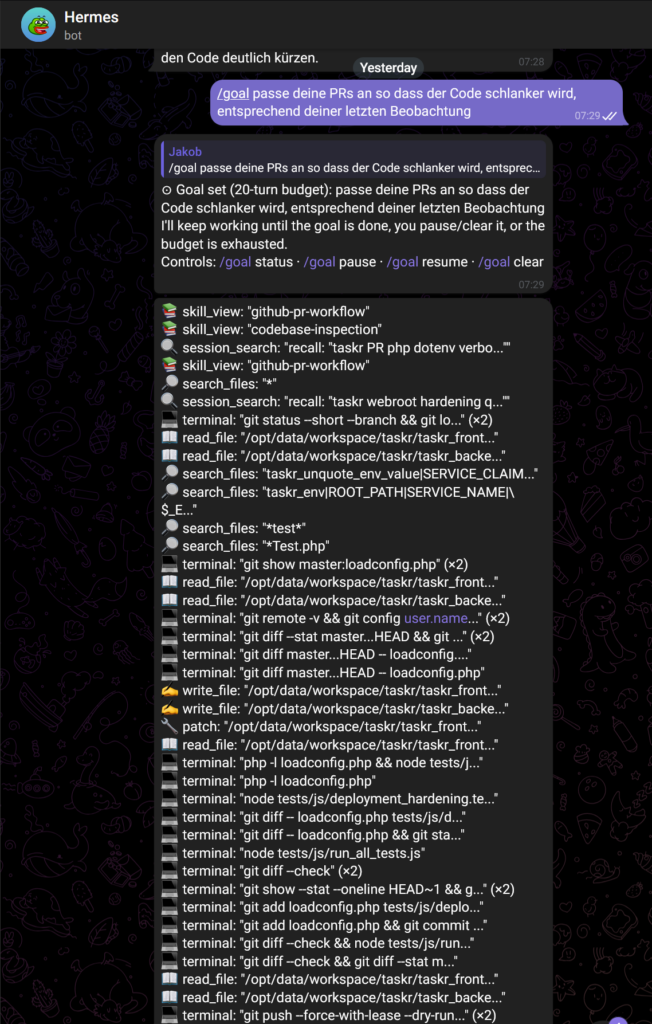
The „/goal“ instruction tells the agent to not stop until the goal has really been reached. This counters the open seen behavior when asking an LLM for a expectation to „fix all 10 bugs“, that it goes to fix 3 bugs and says its done. Goal mode has been pioneered by Anthropic but adopted by Hermes within days (?).
As a consequence, my personal pet project which is a on off story for 5-6 years (still unpublished…) finally got some traction while I was literally lying at the pool in Italy.
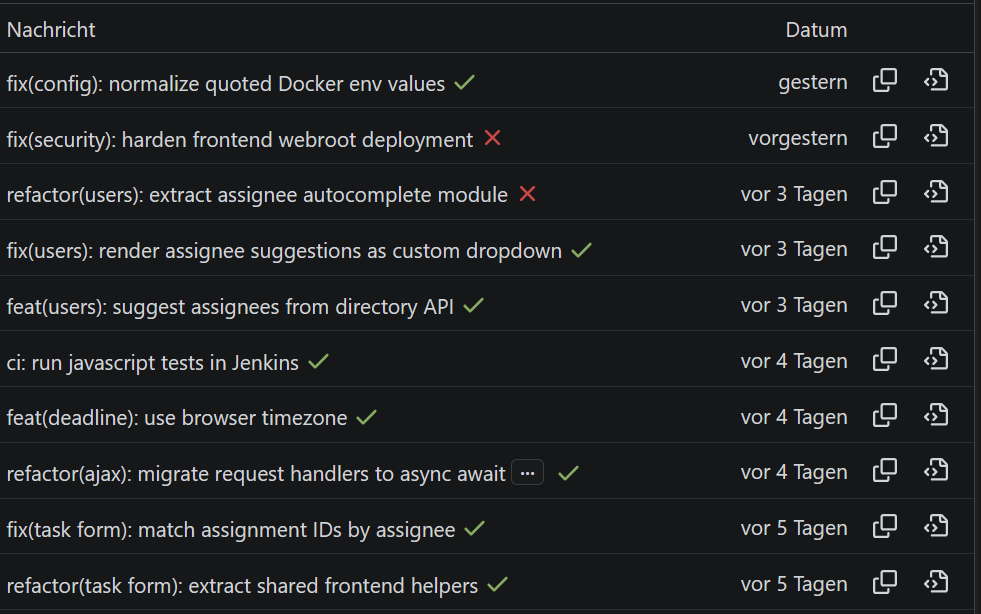
During my family vacation trip to Lake Garda I accidentally made the following screenshot while taking some photos during a boat road on the lake. Just in that moment, my agent reported some task done.